
How Skipper Works
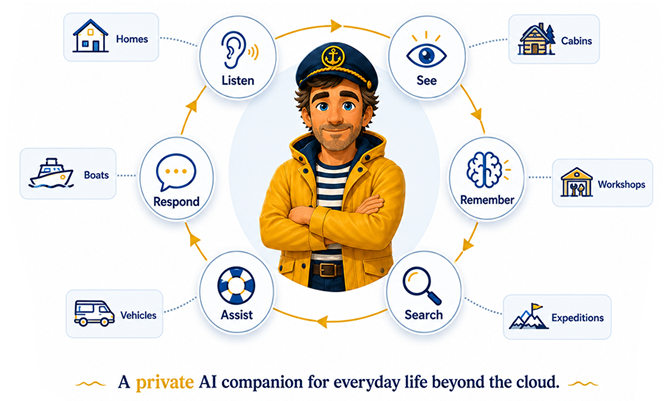
Skipper is a self-contained system made from several pieces of hardware and software working together as one assistant.
At the heart of the system is a compact dedicated computer that runs Skipper’s artificial intelligence, knowledge, memory, voice processing, visual recognition, and automation locally. Rather than sending questions and personal information to an online AI service, the main processing takes place directly within the Skipper system.
One system, several connected parts
The central unit can be connected to a microphone, speakers, display, cameras, storage, and other supported devices. Each part gives Skipper a different way to interact with the user or understand the environment around it.
The microphone allows Skipper to receive spoken requests, while the speakers provide natural voice responses. A connected display offers chat, system controls, stored information, and visual feedback. Cameras can allow Skipper to recognise familiar objects, while reminders, schedules, and supported sensors can provide information about events or changing conditions.
The exact combination of components can vary depending on how and where Skipper is intended to operate.
Installed as a dedicated assistant
Skipper is designed to be installed as a complete, purpose-configured system rather than downloaded as a general application for any computer.
The central unit is placed in a suitable protected location and connected to the required power supply and chosen accessories. Microphones, speakers, displays, and cameras can then be positioned where they are most useful.
Once installed and configured, Skipper operates as a local assistant within that environment. Users can communicate with it through voice or chat, access its stored knowledge, receive reminders and alerts, and use any visual or proactive features included in the installation.
Local knowledge and intelligence
Skipper’s knowledge is stored within the system. Manuals, procedures, recipes, reference documents, facts, and other useful information can be added so that Skipper can search and explain them without relying on an internet connection.
Its memory and settings are also stored locally, allowing the system to retain useful information and adapt its behaviour while keeping the user in control of the data.
Independent by design
Skipper does not require a continuous internet connection or an external cloud-based AI service for its core operation.
Once the system and its knowledge have been prepared, its main features continue to operate locally. This makes Skipper suitable for boats, remote properties, workshops, mobile installations, and other environments where privacy and independence are important.
In simple terms, Skipper is not just software running in the background. It is a dedicated collection of intelligence, knowledge, voice, vision, and hardware brought together as one practical assistant.